Baltic Hats: Little Horses
Little Horses
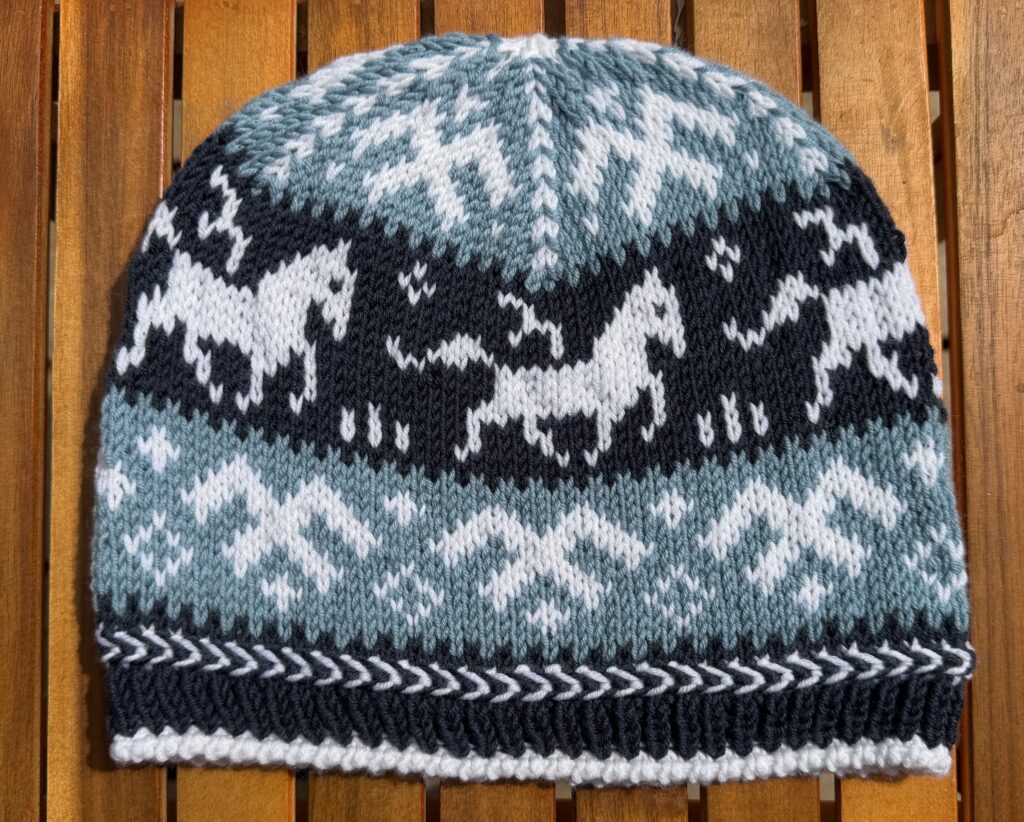
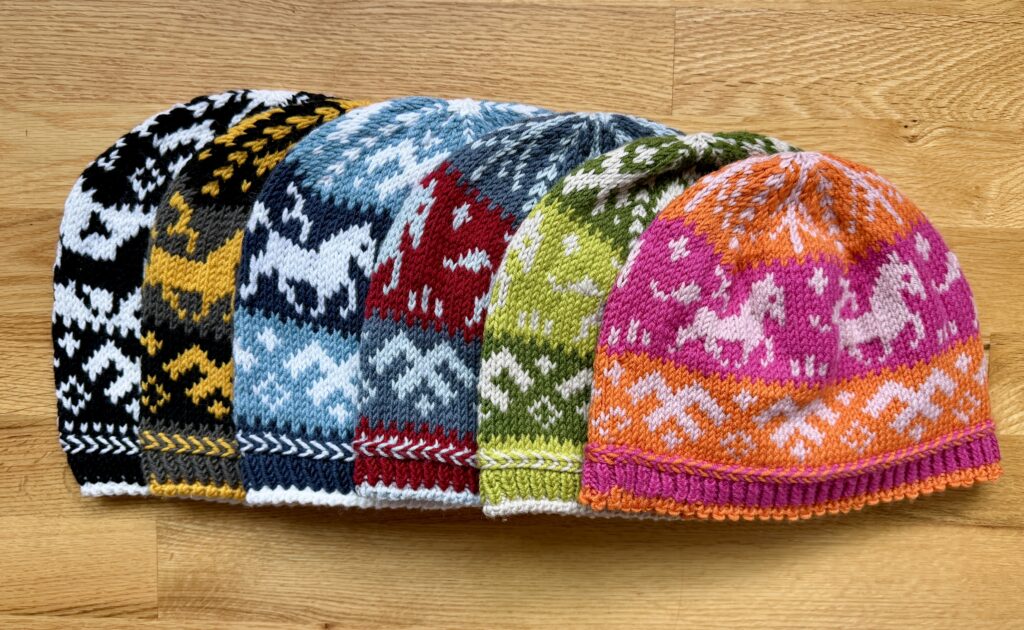
The hat Little Horses, žirgeliai in Lithuanian, is designed with both an ancient symbolic motif and a representational motif. The ancient motif represents twins – twin stalks of grain or twin horses. In Latvia it is associated with Jumis, an ancient Baltic deity of the harvest. In Lithuania, this symbol can depict Ašvieniai, divine twin horses that pull the sun’s (Saulė’s) chariot across the sky. It is a symbol of the harvest and of bounty, fertility and prosperity. In Lithuania, twin horses can be found on the roof gables of traditional homes.
In the Baltic tradition in general, horses were associated with the harvest, farming and war. Horses arrived in Lithuania around 3900 – 3700 BCE. By the third century AD they were commonly found in burial sites. This tradition of burying horses with their owner, was continued until the 14th century with Christianization. Lithuania is home to a breed of a tall pony called the Žemaitukas. These horses were used as war horses in the 13th and 14th centuries and for agricultural labor. It’s an endangered breed, but efforts in Lithuania have helped with reviving the population.
Horses were highly revered and cherished companions. There are many folksongs that feature horses and young men as friends and confidants. In the songs, sometimes the young man talks to his horse and the horse responds. Listen here to the folksong “Šėriau žirgelį” (I Fed My Steed) arranged for choir and sung by the choirs Adoramus and Momentum. The song is about a young man who prepares to go visit his bride. As he nears her home, he hears singing in the cherry orchard. It is his betrothed crying. She cries because she has lost her innocence and youth as represented by the rue. Lithuanian folksongs regarding women and marriage were often sad, the young woman mourning the transition from the freedom of youth to the responsibilities of marriage and adulthood. Young women when betrothed left their homes for that of their in-laws. This life could be good if the mother-in-law were kind, but if she were not, it could be miserable.
Šėriau žirgelį Per savaitėlę, Kai atėjo subatėlė, Savo bėrą žirgelį Pabalnojau. 3×2
Vai žirge žirge, Žirgeli mano, Ar nuneši mane jauną Per pusantros valandėlės Šimtą mylių? 3×2
Nunešt nunešiu, Parnešt parnešiu, Jei pašersi avižėlėm, Pagirdysi vandenėliu, Tai nunešiu. 3×2
O kai aš jojau Pro uošvio dvarą, Čiulba ulba paukšužėliai Žaliam vyšnių sodely, Tai gražiai gieda. 3×2
Vai uošvi uošvi, Uošvi tėveli, Kas ten per paukštelė Žaliam vyšnių sodely Taip gražiai gieda? 3×2
Vai žente žente Žente sūneli, Tai ne paukštė, ne paukštelė, Tiktai mano dukrelė Taip gailiai verkia. 3×2
Vai ko ji verkia, Ko ji raudoja: Ar rūtelė nenuskinta, Vainikėlis nenupintas, Nepernešiotas? 3×2
Vai žente žente Žente sūneli, Jau rūtelė nuskinta, Vainikėlis nupintas, Jau pernešiotas. 3×2
In English (note, Lithuanian possesses the most productive and extensive diminutive systems of any living language. These are represented in English with words like little and sweet, but cannot always be fully translated into English):
I fed my trusted steed all week long, But when the weekend came, I saddled up my dear bay. Oh steed, oh steed , my dearest steed, Can you carry me, a young man, In one and a half hours, a hundred miles? Carry you, I will, bring you back, I will, If you feed me some oats, And will give me water to drink, Then I will carry you. And when I rode past my in- law’s manor, Little birdies chirping, tweeting, In the green cherry orchard—such beautiful sounds. Oh father-in-law, dear father, What is the sweet bird In the green cherry orchard With such a beautiful song? Oh son-in-law, my dear son, It is not a bird, not a sweet birdie, Only my dear daughter Who is sadly weeping. Oh why is she crying, Why is she weeping? Has she not picked the rue, Has she not braided a wreath, Did she not wear it? Oh son-in-law, dear son, The rue has been picked, The wreath has been braided, And it has been worn.
(Translated by BPT)
Another more upbeat folksong features the žemaitukas. You can listen to the song “O Tai Arklys” (Oh, What a Horse) sung by Sutaras here. The link includes lyrics and a translation plus more information about the žemaitukas. A third song here is a sweet love song called “Saulė Nusileido” (The Sun has Set) by FolkLT Ritmai and the lyrics in Lithuanian and English:
Saulė nusileido už aukštų kalnų Kodėl neatjoji, bernužėli tu? Choras: Liūdna, oi liūdna, liūdna be tavęs. Mielas bernužėlį nelankai manęs. Ar žirgo neturi, kelio nežinai? Ar iš rūpestėlių mane pamiršai? Choras: Liūdna, oi liūdna, liūdna be tavęs Mielas bernužėlį nelankai manęs. Ir žirgelį turiu, kelelį žinau? Tik iš rūpestėlių tave pamiršau. Choras: Liūdna, oi liūdna, liūdna be tavęs Mielas bernužėlį nelankai manęs. Žydi bijūnai, žydi raudonai Myliu, mergužėlę, myliu amžinai. Choras: Liūdna, oi liūdna, liūdna be tavęs Mielas bernužėlį nelankai manęs. Mielas bernužėli, nelankai manęs
The sun has set now, set beyond the hills Why my dear laddie are you not riding to me? (Chorus) Sad, oh so sad, its sad without you, My dearest laddie, without a visit from you. Don’t you have a steed, or don’t you know the way, Or are life’s worries keeping you away? (Chorus) sad, oh so sad, it’s sad without you, My dearest laddie, without a visit from you. I have a steed, and I know the way, But all the life’s worries are keeping me away (Chorus) Sad, oh so sad, it’s sad without you. My dearest laddie, without a visit from you. The peonies are blooming, they are blooming red, I love the sweet maiden with an eternal love. (Chorus) Sad, oh so sad, it’s sad without you, My dearest laddie, without a visit from you.
(Translated by BPT)